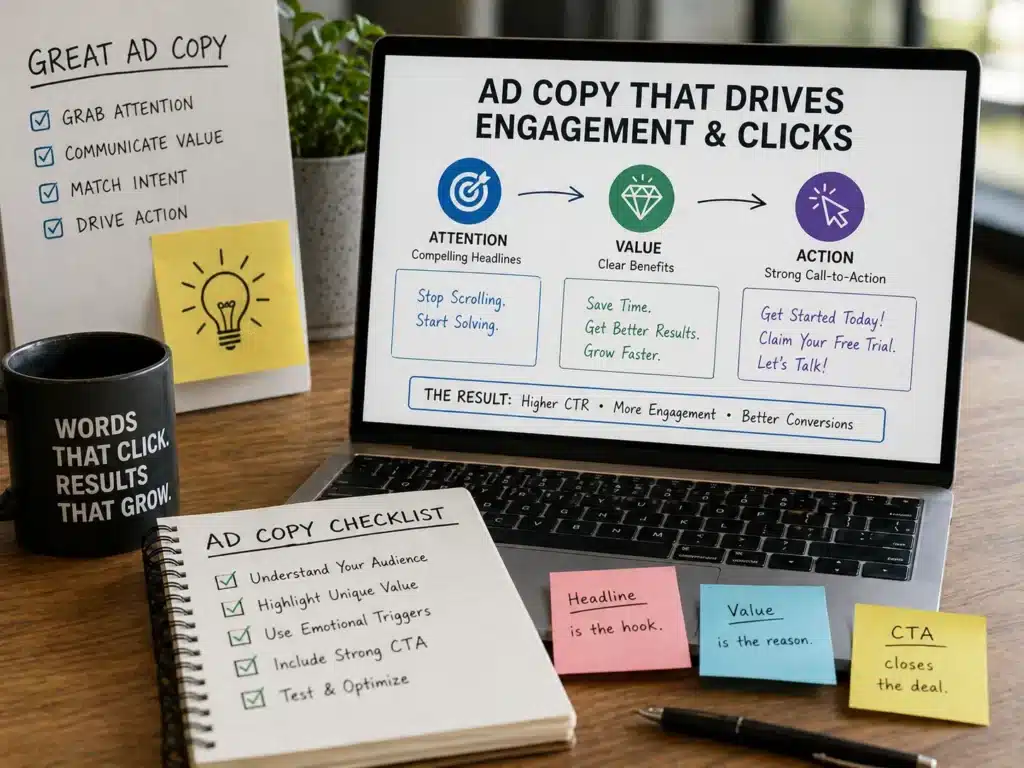
Before someone clicks your ad, they read your words. That single moment—when a user scans a headline or a short description—determines whether your budget turns into traffic or gets ignored. You can have the perfect targeting, the right keywords, and a strong strategy, but if your message doesn’t connect, nothing else matters. That’s why mastering ad copy is essential, especially when paired with strategies like organic SEO to maximize overall visibility and performance.
Ready to Rank Higher?
Talk it through with our CEO, not a salesperson.
Schedule Your Free Consultation →Direct Answer: Ad copy drives engagement and clicks by capturing attention, matching user intent, and clearly communicating value, ultimately influencing click-through rates and conversions.
Why Ad Copy Is the First Impression That Matters
Ad copy is often the first interaction a user has with your brand. In a crowded search or social feed, it acts as your digital handshake.
A strong first impression:
- Grabs attention instantly
- Communicates relevance
- Encourages action
If your copy fails to stand out, users will scroll past—regardless of how well-targeted your campaign is.
Understanding User Intent Before Writing Copy
Effective ad copy starts with understanding what the user wants. Without this, even well-written ads can fall flat.
Intent types include:
- Informational – Looking for answers
- Transactional – Ready to buy
- Comparative – Evaluating options
Matching your copy to intent ensures higher engagement and better performance.
The Power of Headlines in Capturing Attention
The headline is the most critical part of your ad. It determines whether users continue reading or move on.
Effective headlines:
- Address a problem
- Highlight a benefit
- Create urgency
| Weak Headline | Strong Headline |
|---|---|
| “Marketing Services Available” | “Struggling to Get Leads? Fix It Today” |
A compelling headline sets the stage for engagement.
Writing Descriptions That Drive Action
Once the headline captures attention, the description must convince users to click.
Strong descriptions:
- Expand on the headline
- Highlight unique value
- Include a clear call-to-action
Clarity and relevance are key. Users should immediately understand what they gain by clicking.
Emotional Triggers and Their Impact on Engagement
Emotion plays a major role in decision-making. Ads that connect emotionally tend to perform better.
- Fear – Avoiding loss
- Desire – Achieving goals
- Trust – Feeling confident
Incorporating emotional triggers makes your copy more persuasive and memorable.
Keyword Integration Without Sounding Robotic
Keywords are essential for relevance, but overusing them can make your copy sound unnatural.
Best practices include:
- Use keywords naturally
- Avoid keyword stuffing
- Focus on readability
This approach aligns with broader strategies in Search Engine Optimization, where balance between optimization and user experience is critical.
Ad Copy and Its Influence on Click-Through Rate
Click-through rate (CTR) measures how often users click your ad. Strong copy directly impacts this metric.
Higher CTR means:
- Better engagement
- Higher Quality Score
- Lower cost per click
Improving your copy is one of the fastest ways to boost performance.
Localizing Ad Copy for Better Results
For businesses targeting specific areas, localized copy can significantly improve engagement.
This is especially important when combined with local SEO strategies.
- Include city names
- Reference local needs
- Highlight proximity
Localized messaging makes your ads more relevant to nearby users.
Testing and Optimizing Ad Copy
Ad copy is not static—it requires continuous testing and refinement.
- A/B test headlines
- Experiment with calls-to-action
- Analyze performance data
Small changes can lead to significant improvements in results.
Common Ad Copy Mistakes to Avoid
Even experienced marketers make mistakes that hurt performance.
- Being too vague
- Ignoring user intent
- Lacking a clear call-to-action
- Overloading with information
Avoiding these pitfalls ensures your ads remain effective.
The Long-Term Impact of Strong Ad Copy
Great ad copy doesn’t just drive clicks—it builds brand perception and trust over time.
- Improves brand recognition
- Increases customer loyalty
- Enhances overall marketing performance
Consistency in messaging strengthens your brand’s voice.
Final Thoughts on Ad Copy and Engagement
Ad copy is more than just words—it’s the bridge between your audience and your offer. It determines whether your campaigns succeed or fail.
By focusing on clarity, relevance, and emotional connection, you can create ads that not only attract attention but drive meaningful results. For businesses looking to elevate their campaigns, partnering with experts like GetPhound can help turn messaging into measurable performance.Before someone clicks your ad, they read your words. That single moment—when a user scans a headline or a short description—determines whether your budget turns into traffic or gets ignored. You can have the perfect targeting, the right keywords, and a strong strategy, but if your message doesn’t connect, nothing else matters. That’s why mastering ad copy is essential, especially when paired with strategies like organic SEO to maximize overall visibility and performance.
Direct Answer: Ad copy drives engagement and clicks by capturing attention, matching user intent, and clearly communicating value, ultimately influencing click-through rates and conversions.
Why Ad Copy Is the First Impression That Matters
Ad copy is often the first interaction a user has with your brand. In a crowded search or social feed, it acts as your digital handshake.
A strong first impression:
- Grabs attention instantly
- Communicates relevance
- Encourages action
If your copy fails to stand out, users will scroll past—regardless of how well-targeted your campaign is.
Understanding User Intent Before Writing Copy
Effective ad copy starts with understanding what the user wants. Without this, even well-written ads can fall flat.
Intent types include:
- Informational – Looking for answers
- Transactional – Ready to buy
- Comparative – Evaluating options
Matching your copy to intent ensures higher engagement and better performance.
The Power of Headlines in Capturing Attention
The headline is the most critical part of your ad. It determines whether users continue reading or move on.
Effective headlines:
- Address a problem
- Highlight a benefit
- Create urgency
| Weak Headline | Strong Headline |
|---|---|
| “Marketing Services Available” | “Struggling to Get Leads? Fix It Today” |
A compelling headline sets the stage for engagement.
Writing Descriptions That Drive Action
Once the headline captures attention, the description must convince users to click.
Strong descriptions:
- Expand on the headline
- Highlight unique value
- Include a clear call-to-action
Clarity and relevance are key. Users should immediately understand what they gain by clicking.
Emotional Triggers and Their Impact on Engagement
Emotion plays a major role in decision-making. Ads that connect emotionally tend to perform better.
- Fear – Avoiding loss
- Desire – Achieving goals
- Trust – Feeling confident
Incorporating emotional triggers makes your copy more persuasive and memorable.
Keyword Integration Without Sounding Robotic
Keywords are essential for relevance, but overusing them can make your copy sound unnatural.
Best practices include:
- Use keywords naturally
- Avoid keyword stuffing
- Focus on readability
This approach aligns with broader strategies in Search Engine Optimization, where balance between optimization and user experience is critical.
Ad Copy and Its Influence on Click-Through Rate
Click-through rate (CTR) measures how often users click your ad. Strong copy directly impacts this metric.
Higher CTR means:
- Better engagement
- Higher Quality Score
- Lower cost per click
Improving your copy is one of the fastest ways to boost performance.
Localizing Ad Copy for Better Results
For businesses targeting specific areas, localized copy can significantly improve engagement.
This is especially important when combined with local SEO strategies.
- Include city names
- Reference local needs
- Highlight proximity
Localized messaging makes your ads more relevant to nearby users.
Testing and Optimizing Ad Copy
Ad copy is not static—it requires continuous testing and refinement.
- A/B test headlines
- Experiment with calls-to-action
- Analyze performance data
Small changes can lead to significant improvements in results.
Common Ad Copy Mistakes to Avoid
Even experienced marketers make mistakes that hurt performance.
- Being too vague
- Ignoring user intent
- Lacking a clear call-to-action
- Overloading with information
Avoiding these pitfalls ensures your ads remain effective.
The Long-Term Impact of Strong Ad Copy
Great ad copy doesn’t just drive clicks—it builds brand perception and trust over time.
- Improves brand recognition
- Increases customer loyalty
- Enhances overall marketing performance
Consistency in messaging strengthens your brand’s voice.
Final Thoughts on Ad Copy and Engagement
Ad copy is more than just words—it’s the bridge between your audience and your offer. It determines whether your campaigns succeed or fail.
By focusing on clarity, relevance, and emotional connection, you can create ads that not only attract attention but drive meaningful results. For businesses looking to elevate their campaigns, partnering with experts like GetPhound can help turn messaging into measurable performance.